Saturday, December 17, 2011

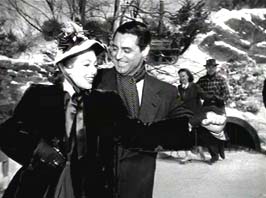
The Bishop's Wife (1947)


THE BISHOP'S WIFE
Henry Koster
1947 • 109 Minutes • 1.37:1 • United States
RKO

Principal Cast: Cary Grant, Loretta Young, David Niven, Monty Woolley, James Gleason, Gladys Cooper
Screenplay:  Robert E. Sherwood, Leonardo Bercovici based on the novel by Robert Nathan
Producer:  Samuel Goldwyn
Cinematography:  Gregg Toland

Awards & Honors

Academy Awards
Winner: Best Sound, Recording - Gordon Sawyer
Nominated: Best Director - Henry Koster 
Nominated: Best Film Editing - Monica Collingwood 
Nominated: Best Music, Scoring of a Dramatic or Comedy Picture - Hugo Friedhofer
Nominated: Best Picture - Samuel Goldwyn Productions


The Essential Films


 Sometimes angels rush in where fools fear to tread. 

A true holiday classic.  A bishop is lost and without direction and desperately needs to raise money for a new church.  He prays for help and guidance, but feels he receives none.  However, he does receive help in the form of an angel named Dudley.  Dudley is incredibly charming (after all, he IS played by Cary Grant) as an assistant to the bishop.  Everyone falls for him, especially the bishop's wife (played by Loretta Young.)  Bishop Henry becomes increasingly frustrated and jealous of Dudley and what develops is a film that expertly showcases the fine acting abilities of its three leads.  It has a great holiday feel to it and both Grant and the film are incredibly charming.

Friday, December 16, 2011

The 12 Days of Essential Christmas Films

It's that time of year again.  


Christmas is a time of sharing, love, peace and goodwill to all men...


...and of course it's a time for great movies.  There are many Christmas films out there, ranging from overly sentimental to the dark and twisted.  Some are good, some are bad, some are ugly.  But only a few of them are essential holiday viewing.  With that said, here are the 12 Days of Essential Christmas Films.


And here...we...go...


THE MUPPET CHRISTMAS CAROL
1992
Directed by:  Brian Henson
Starring:  Michael Caine, Frank Oz, Dave Goelz, Steve Whitmire

"Charles Dickens":  Hello!  Welcome to the Muppet Christmas Carol!  I am here to tell the story.

Rizzo The Rat:  And I am here for the food.

Michael Caine is Ebeneezer Scrooge. Kermit the Frog is Bob Cratchit.  Miss Piggie is Mrs. Cratchit.  Fozzy Bear as Fozzywig (get it?)  Statler and Waldorf as Jacob and Robert Marley.  And The Great Gonzo as Charles Dickens.  The Muppet Christmas Carol remains to this day my favorite adaptation of Dickens' classic story.  Caine is absolutely vile as the iconic Scrooge, which makes his transformation at the end of the film far more effective than other interpretations.  What makes the film so wonderful is the effortless blending of the story everybody knows with the signature Muppet humor.  Don't let the fact that there are Muppets in the film fool you, it's still very effective as a heartwarming holiday film.


1947
Directed by:  Henry Coster
Starring:  Cary Grant, David Niven, Loretta Young

Sometimes angels rush in where fools fear to tread. 

A true holiday classic.  A bishop is lost and without direction and desperately needs to raise money for a new church.  He prays for help and guidance, but feels he receives none.  However, he does receive help in the form of an angel named Dudley.  Dudley is incredibly charming (after all, he IS played by Cary Grant) as an assistant to the bishop.  Everyone falls for him, especially the bishop's wife (played by Loretta Young.)  Bishop Henry becomes increasingly frustrated and jealous of Dudley and what develops is a film that expertly showcases the fine acting abilities of its three leads.  It has a great holiday feel to it and both Grant and the film are incredibly charming.


JOYEUX NOËL 
(Merry Christmas)
2005
Directed by Christian Carion
Starring:  Diane Kruger, Benno Fürmann, Guillaume Canet, Daniel Brühl

Tonight, these men were drawn to that altar like it was a fire in the middle of winter. Even those who aren't devout came to warm themselves.

You may not have heard of this European film that had a very limited release in the United States.  The story revolves around a miracle that took place during Christmas Eve, 1914 in the middle of World War I.  Four characters are profiled:  a priest in the Scottish army, a French lieutenant, a German soldier who is also a famous tenor and his wife.  On the night before Christmas, hostilities temporarily cease and the soldiers leave their trenches and spend Christmas with the enemy.  Writer/Director Carion and the excellent cast do an amazing job of bringing this film to life.  Even more amazing was that film is based on a true story.  The true strong point of the film lies in the fact that you can take what you want from this film.  Whether the soldiers stopped fighting was brought on by God, Christmas or just the disgust with the horrors of war is up for interpretation.  Whatever you take from it, realize that this is a new classic in holiday films.


(A Christmas Carol)
1951
Directed by:  Brian Desmond Hurst
Starring:  Alistair Sim, Mervyn Johns, Michael Hordern, Francis De Wolff, Miles Malleson

Before I draw nearer to that stone, tell me! Are these the shadows of things that must be, or are they the shadows of things that MIGHT be? 

The Muppet Christmas Carol is my favorite adaptation of this story, however, Scrooge is perhaps the best and most faithful retelling.  That says a lot, considering the story has been adapted 53 times on film and in television since 1901.  Even more impressive is that Sim is, in this blogger's opinion, the best on-screen Ebeneezer Scrooge of all time.  This includes a diverse list of actors ranging anywhere from Albert Finney to Patrick Stewart to Jim Carey.  He excels at being both cruel and menacing as well as childishly hilarious.  It leaves no part of the story untouched and gives more back story to Scrooge in the "Past" segment than any other film has done to date.  


1983
Directed by:  Bob Clark
Starring:  Peter Billingsley, Melinda Dillon, Darren McGavin

Oh my god, I shot my eye out!

Every child knows what's it's like to want that perfect Christmas present.  The longing, the pleading, the desperation of that ONE THING that you just can't live without.  A Christmas Story is the simple tale of Ralphie, a little boy who wants nothing more for Christmas than a B.B. gun.  Not just any B.B. gun, mind you, but an Official Red Ryder Carbine-Action Two-Hundred-Shot Range Model Air Rifle (with this thing that tells time.)  It seems everyone is against him... his mother, his teacher... heck, even Santa thinks he'll shoot his eye out.  But Ralphie is unrelenting in his desire for this perfect gift.  This film is timeless, because even though it was made in the 80s, and takes place in the 40s, everyone, young and old, can relate to Ralphie.  A Christmas Story perfectly captures exactly what it's like to be a kid on Christmas.


1942
Directed by:  Mark Sandrich
Starring:  Bing Crosby, Fred Astaire, Marjorie Reynolds

Ted:  I like it here... with you and Linda. 
Jim: And we love having you. When are you leaving? 

The movie that gave birth to not just one of the most popular Christmas songs of all time, but one of the most popular songs EVER.  More on that in a second.  Bing Crosby was one of the most popular entertainers in his day, so Paramount Pictures gave him a huge budget to do a musical.  What does he spend the money on?  Hiring the legendary dance man Fred Astaire as his co-star and Irving Berlin as his song writer and they produce one of the most charming musicals ever made.  The story follows song-and-dance entertainers Jim Hardy and Ted Hanover (Crosby and Astaire respectively) as they compete for the affections of the same girl.  Jim has reason to be nervous as Ted has stolen one of his girls in the past.  Jim quits show business to run a hotel that is only open on holidays and hires Linda Mason (Reynolds) as a performer.  When Ted realizes that not only is Linda beautiful, but an amazing singer and dancer he schemes to once again steal a girl away from Jim.  Crosby is always praised for his singing, but not enough for his comedic acting... and paired with Fred Astaire, the two have great comedic chemistry.  All the songs for each holiday are fun (though you may want to skip the "Abraham" number because in 1942 doing a song in black face wasn't considered racially insensitive) but the show stealer is "White Christmas" which as I mentioned before became one of the biggest songs of all time.  It's popularity was mostly due to the requests of soldiers fighting the war in Europe who desperately wanted to be reminded of home.


1954
Directed by:  Michael Curtiz
Starring:  Bing Crosby, Danny Kaye, Rosemary Clooney, Vera Ellen

Let's just say we're doing it for an old pal in the army.

12 years after "White Christmas" became a huge hit, Bing Crosby and Irving Berlin teamed up again and made it the title of another Christmastime musical.  This time around Danny Kaye replaces Fred Astaire as the dance man.  Kaye, while not as "legendary" as Fred Astaire, still did not disappoint as all his dance numbers with Vera Allen were a hell of a lot of fun to watch.  Rosemary Clooney played Crosby's love interest and will leave a great impression on you with her magnificent voice.  Crosby and Kaye play two old army buddies that teamed up as a song and dance duo turned producers after the war.  They are so over-worked that Phil (Kaye) is just getting plain sick and tired of constantly being around Bob (Crosby.)  He never misses an opportunity to play matchmaker with any pretty girl that walks into Bob's life just so that he can get some time away from his partner.  Enter the Betty & Judy Haynes, a pair of sisters hoping that Bob and Phil will give them a shot in one of their shows.  After the getting the girls out of a jam, the four entertainers head to Vermont for the holidays where Bob and Phil realize that the ski lodge they're staying at is being run by their old army general.  Seeing the sad state of affairs the lodge is in, Bob, Phil, Betty and Judy start planning a big Christmas spectacle to hopefully attract visitors.  The big closing number?  You guessed it.


MIRACLE ON 34TH STREET
1947
Directed by:  George Seaton
Starring:  Maureen O'Hara, John Payne, Edmund Gwenn, Gene Lockhart, Natalie Wood

Faith is believing when common sense tells you not to. Don't you see? It's not just Kris that's on trial, it's everything he stands for. It's kindness and joy and love and all the other intangibles. 

One of the most warm-hearted films ever made, Miracle on 34th Street depicts the trial of a Macy's store Santa Claus who truly believes he is THE Santa Claus, but at its heart, it's a film about faith.  Not just for the other characters, but for the audience itself.  When we are first introduced to Kris Kringle, he is walking the streets of New York on Thanksgiving Day.  You don't see him with any reindeer, you don't seem him at the North Pole and the only sleigh he rides in is the one in the Macy's Thanksgiving Day parade.  Naturally, since he is the hero of the story, there is an implied trust between the protagonist and the viewer.  We believe what he presents to us.  No matter how ludicrous it may seem.  Unlike most movies about Santa Claus, this film has no magic moments.  Heck, the most amazing thing Kris does is speak Dutch to a little Dutch orphan.  Something certainly anybody with a proper background could do.  He brings people together at Christmastime, and slowly convinces every one around him that he is the real deal.  Most of this of course is due to the wonderful acting abilities of Edmund Gwenn, who won an Oscar for his portrayal of Kris.  "Faith is believing in something when common sense tells you not to."  That is a line repeated in the movie... and by the end of the film, we as the audience truly believe that Kris IS Santa, despite having no proof.  And there in lies the true miracle of the film.


MEET ME IN ST. LOUIS
1944
Directed by:  Vincente Minnelli
Starring:  Judy Garland, Margaret O'Brien, Mary Astor

 It's our last dance in St. Louis. I feel like I'm going to cry.

Unlike most of the films on this list, Meet Me in St. Louis is a film that doesn't primarily take place DURING Christmas.  In fact, the only extended Christmas scene doesn't happen until towards the end of the film.  However, much like Holiday Inn, this film was responsible for another immortal Christmas song that you hear every year:  "Have Yourself a Merry Little Christmas."  Most people don't realize that song is not a "happy" Christmas song, it's actually bittersweet as it is sung at a very sad and poignant moment in the film.  The film follows a close-knit family in suburban St. Louis through the year of 1904 as they live pleasant lives, fall in love, celebrate holidays and have good times with each other.  It is the perfect picture of Middle Class America.  Everything is perfect in this little corner of the world.  There is a pall over the year, however, as the head of the family wishes to move the entire family off to New York where better financial opportunities await him.  On the eve of their departure, at Christmas, Judy Garland tries to comfort her younger sister by singing "Have Yourself a Merry Little Christmas."  The message of the song being, "Don't let this move ruin your Christmas.  Don't mourn the loss of your home, but cherish the memories you have."  This film is essential holiday viewing not only for its classic song, but also for its strong themes of the love of your family and how there is no place like home. (A message Judy Garland isn't unfamiliar with.)


1940
Directed by: Ernst Lubitsch
Starring:  James Stewart, Margaret Sullivan

Psychologically, I'm very confused... But personally, I don't feel bad at all. 

I have often said that I hate romantic comedies.  I feel they are formulaic, dull and predictable.  Furthermore, just as Playboy give men unrealistic expectations of women, romantic comedies are just as guilty of giving women unrealistic expectations of men.  The exception to this rule, of course, is any romantic comedy made before 1950.  This was a time when they weren't formulaic (well, maybe a little), the characters were fleshed out and developed, the stories were tight and well scripted, and, of course, the two leads were incredibly charming.  I mean, can you really compare Clark Gable and Humphrey Bogart with Ashton Kutcher and Robert Pattinson?  No.  You can't.  I digress.  The Shop Around the Corner is a romantic comedy, plain and simple.  It's Christmas time and Klara (Margaret Sullivan) and Alfred (James Stewart) are both employees at the same baggage store, constantly competing for customers and THEY CAN'T STAND EACH OTHER.  Here's the kicker, though:  Each one of them has a pen pal that they've never met... and it just so happens that it turns out that they are each other's pen pal.  They write love letters to each other, not knowing that the person they are professing love to is someone they'd like to throw in front of a bus.  If this sounds familiar it's because it was unremarkably re-made in 1998 as You've Got Mail, this time with an e-mail angle.  Skip that one.  Watch this one.  Not very Christmas-y other than it takes place during the holidays, but it's charming, fun and probably one of the best romantic comedies ever filmed.


EDWARD SCISSORHANDS
1990
Directed by Tim Burton
Starring:  Johnny Depp, Winona Ryder, Diane Weist, Anthony Michael Hall, Alan Arkin, Vincent Price

If he weren't up there now... I don't think it would be snowing. Sometimes you can still catch me dancing in it. 

Edward Scissorhands is often left off "Best Holiday Films" lists, why I'm not sure.  It is one of the GREAT Christmas films.  If you go into this film as a comedy (like the producers advertised it), you'll be disappointed.  While it certainly has many humorous moments, this movie is much more of a fantasy.  A modern day fairy tale.  Edward is a creation that was built by a scientist who was trying to create a man.  Even though he was a "creator," he was the only father, and family, that Edward ever knew... and sadly he died before Edward was "finished," leaving Edward with scissors for hands.  Years later he is rescued from isolation by a kindly Avon lady, who unofficially adopts him.  At first Edward is welcomed by the small suburban neighborhood, and they take advantage of his handicap by putting him to use trimming hedges and cutting hair.  But Edward's heart truly lies with Kim, the daughter of the woman who rescued him.  What develops is a love straight out of a story book fairy tale, however without a fairy book ending.  What makes this a Christmas movie?  Other than the fact that the film takes place during Christmas, it has a charming theory on the origins of snow.  When people describe a film as "hauntingly beautiful," this is what they're talking about.  Edward Scissorhands is Tim Burton's masterpiece.


1946
Directed by:  Frank Capra
Starring:  James Stewart, Donna Reed, Lionel Barrymore, Thomas Mitchell, Henry Travers

Strange, isn't it? Each man's life touches so many other lives. When he isn't around he leaves an awful hole, doesn't he? 

I don't care what anyone says, It's a Wonderful Life, after over 60 years is STILL the greatest Christmas movie ever made.  It may be cliche, but there is not one film better.  On top of that, it makes the Top 5 of The Essential Films' Top 100 Movies of All Time (Coming Soon.)  It's better than Citizen Kane.  Better than Star Wars.  Better than Gone With The Wind.  I watch it every single year, and so should every one.  By those who've never seen it and by those who've seen it dozens of times.  It's message is universal and timeless.  A man who sacrifices his entire life for every family member, friend and sometimes complete stranger just because it's the right thing to do... well one day, he gets in trouble.  He's so desperate he considers committing suicide on Christmas Eve.  A guardian angel intervenes and prevents him from doing so. When George remarks that perhaps the world would have been a better place had he not even existed, the angel decides to show him exactly what the world would be like.  The message of the film is that everyone matters and everyone touches everyone else's life in some way.  You should value and cherish not just your life, but all lives.  And at the end of the day, no man is failure who has friends.  

Tuesday, December 13, 2011

Die Hard (1988)

This post was originally published on SuperfriendsUniverse.com as part of the "Movies Every Man Should Own" series on December 7, 2011.


DIE HARD

John McTiernan
1988 • 131 Minutes • 2.20:1 • United States
20th Century Fox

Principal Cast – Bruce Willis, Alan Rickman, Bonnie Bedlia, Reginald VelJohnson, Paul Gleason
Screenplay – Jeb Stuart, Steven E. de Souza
Producers – Joel Silver, Lawrence Gordon
Cinematography – Jan De Bont

Awards

Academy Awards – Best Effects, Sound Effects Editing (Nomination)
Academy Awards – Best Effects, Visual Effects (Nomination)
Academy Awards – Best Film Editing (Nomination)
Academy Awards – Best Sound (Nomination)
American Film Institute’s 100 Most Thrilling Movies (#39)
American Film Institute’s 50 Greatest Movie Villains (Hans Gruber – #46)
DVD of the Day’s 100 Greatest Movie Bad-Asses (John McClane – #1)
The Essential Film’s 100 Greatest Movie Villains (Hans Gruber – #7)

Now I have a machine gun. Ho Ho Ho.  

Plot:  New York City cop John McClane heads to Los Angeles to visit his estranged wife and children in time for the holidays.  But shortly after he arrives at his wife’s high-rise office building a group of terrorists invade, killing and wreaking havoc on the holy night of Christmas Eve.  It’s up to McClane to take down the terrorists by himself…

WHY SHOULD YOU OWN IT?

John McTiernan

By 1988 John McTiernan had directed an action classic in Predator.  Could he repeat the same success with Die Hard?  The short answer? Yes.  Not only was Die Hard more financially successful (quite a feat for the director’s third film), but it exceeded the sci-fi/horror shoot ‘em up’s action packed scenes.  McTiernan is one of the the best action director’s of all time, having also gone on to helm The Hunt for Red October, Die Hard with a Vengeance and The Thomas Crown Affair.   When it comes to action, this guy knows what he’s doing.  Die Hard is jam packed with amazing sequences… from John McClane’s escape in the elevator shaft, to the destruction of an LAPD SWAT tank (“The quarterback is toast!”) and of course McClane jumping off the top of a 40-story building to escape an exploding helicopter.  All of it looks as good in 2011 as it did in 1988.

The Script

Jeb Stuart and Steven E. de Souza pen an extremely tight and well-put-together screenplay… a rarity for any action movie.  From the opening scene it sets up and foreshadows future events.  A businessman tells McClane to take off his shoes and make “fists with his toes” to relax.  Later, when McClane is doing just that, the terrorists attack and he has no time to put on his shoes.  This leads him to spend the ENTIRE MOVIE barefoot, which proves disastrous when he has to escape the bad guys by running through glass.  There are other little moments just like this in the film.  The entire movie from start to finish makes sense, with each event (big or small) having an impact on the next.  Stuart/de Souza’s gift of writing also serves them well in the dialogue department.  Not only do they sprinkle great lines throughout the script (“Yippee-Kay-Yay Motherfucker”), but the radio conversations between McClane and his only ally, Sgt. Al Powell, are captivating. They also heavily rely on (gasp!) character development.  McClane is a fully realized character.  Now, in the future sequels he does become more of a caricature, but in the original he is a desperate man, determined not only to defeat the bad guys, but also reunite and reconcile with his wife.  Powell, his only ally in the movie, also has a nice little story arc that climaxes nicely at the end of the film (no spoilers here.)  And of course, who can forget the great Hans Gruber character?  Excellently written, but even more excellently acted. Speaking of….

Alan Rickman

Modern audiences probably most recognize Alan Rickman as the despicable Professor Snape from the Harry Potter franchise.  While he’s a veteran actor, American audiences first noticed him as the delightfully villainous Hans Gruber in Die Hard.  Gruber is the smooth-talking, calculating and evil terrorist (or is he?) that has taken over Nakotomi Tower.  He is absolutely the Lex Luthor to McClane’s Superman… relying on intellect instead of brawn.  He, by far, has the best lines in the film and Rickman just plays him to perfection.  Gruber just oozes evil and it’s so much fun to watch.

Bruce Willis

In 1988, Bruce Willis was mostly known for his work on the television show “Moonlighting.” And while the show was a good launch pad for his career, Die Hard was his star-making performance.  And it’s easy to see why.  He’s completely believable as the bad ass New York cop that will stop at nothing to take down the invading terrorists.  He has built his entire career around the John McClane character since then, much like Samuel L. Jackson has built his career on the Jules persona from Pulp Fiction.  Bruce Willis cements himself as one of the greatest action movie heroes ever and it is no coincidence that he topped the list of this website’s 100 Greatest Movie Bad-Asses.

Conclusion

Die Hard is a great alternative to the sugary-sweet Christmas movies that come around every December (not that there’s anything wrong with that), but also it just may be the greatest action movie of all time.

Yippee-Kai-Yay.

Monday, December 12, 2011

The 2011 AFI Film & Television Honorees

Every year, the American Film Institute announces its official top 10 films and television programs of the year.  Making the list this year are Hugo, Bridesmaids, The Descendants and Moneyball.  Television shows joining the list this year are viewer favorites such as "Curb Your Enthusiasm," "Game of Thrones" and "Breaking Bad."  Watch the video below:

Tuesday, December 6, 2011

Meet John Doe (1941)


MEET JOHN DOE
Frank Capra
1941 • 122 Minutes 1.37:1 • United States
Warner Bros. 

Principal Cast - Gary Cooper, Barbara Stanwyck, Edward Arnold, Walter Brennan
Screenplay - Richard Connell & Robert Presnell Sr.
Producer - Frank Capra
Cinematography - George Barnes

Awards
  • Academy Award for Best Writing (Story) - Nomination

I don’t read no papers, and I don’t listen to radios either. I know the world’s been shaved by a drunken barber, and I don’t have to read it.  

After being fired from her job as a newspaper columnist, Ann Mitchell (Barbara Stanwyck) forges a letter to the editor from the fictional “John Doe,” a disgruntled and unemployed would-be prophet who threatens to kill himself on Christmas Eve because of his dissatisfaction in the state of the country.  Unexpectedly, “Doe” gains a huge following and the paper is forced to re-hire Mitchell as well as hire a homeless man, John Willoughby (Gary Cooper), to portray him for public appearances.  Initially both Ann and John are in it for the money, but they are soon caught up in the same rhetoric and philosophy they are selling to the public.  The country unites behind John Doe, but DB Norton, the sinister newspaper publisher, has other ideas for Doe…

This movie is perfect example of Frank Capra’s mastery of making populist entertainment.  His heroes are likeable, charming and, of course, have loads of high moral standards.  However, this film is a tad darker than other Capracorn like Mr. Smith Goes to Washington or Mr. Deeds Goes To Town.  The climactic scene on top of City Hall where John Doe is about to commit suicide on Christmas Eve is dark and forboding, and almost a foreshadowing of Capra’s most famous film, It’s a Wonderful Life, where Jimmy Stewart’s George Bailey is considering the same action on the same night.  Gary Cooper’s John Doe is charming, but Cooper has always been good at playing the down-to-Earth, humble do-gooders (Sergeant York).  Stanwyck is her usual delightful self… playing the jaded newspaper columnist with a heart of gold, and the two stars have a nice onscreen chemistry.

Meet John Doe is an often-forgotten gem that should be watched every Christmas season to remind us what the season is all about.

Wednesday, November 23, 2011

3 Essential Thanksgiving Films

Let's face it, when it comes to holiday films, Christmas has monopolized the market.  But what about the other family-centered holiday?  Thanksgiving is a time of year when families get together and eat turkey... but also a time when big films are released.  This year, 2011 turkey day brings us The Muppets and Hugo, both long-awaited releases.  Movies like The Wizard of Oz and Gone With the Wind have historically been broadcast on Thanksgiving Day as well.  So with today's blog let's celebrate those rare movies that celebrate annual autumn holiday that gives us pause to say thanks.  Here are 3 Essential Thanksgiving Films:


MIRACLE ON 34TH STREET
1947
Directed by:  George Seaton
Starring:  Maureen O'Hara, John Payne, Edmund Gwenn, Gene Lockhart, Natalie Wood

Faith is believing when common sense tells you not to. Don't you see? It's not just Kris that's on trial, it's everything he stands for. It's kindness and joy and love and all the other intangibles. 

One of the most warm-hearted films ever made, Miracle on 34th Street depicts the trial of a Macy's store Santa Claus who truly believes he is THE Santa Claus, but at its heart, it's a film about faith.  Not just for the other characters, but for the audience itself.  When we are first introduced to Kris Kringle, he is walking the streets of New York on Thanksgiving Day.  You don't see him with any reindeer, you don't seem him at the North Pole and the only sleigh he rides in is the one in the Macy's Thanksgiving Day parade.  Naturally, since he is the hero of the story, there is an implied trust between the protagonist and the viewer.  We believe what he presents to us.  No matter how ludicrous it may seem.  Unlike most movies about Santa Claus, this film has no magic moments.  Heck, the most amazing thing Kris does is speak Dutch to a little Dutch orphan.  Something certainly anybody with a proper background could do.  He brings people together at Christmastime, and slowly convinces every one around him that he is the real deal.  Most of this of course is due to the wonderful acting abilities of Edmund Gwenn, who won an Oscar for his portrayal of Kris.  "Faith is believing in something when common sense tells you not to."  That is a line repeated in the movie... and by the end of the film, we as the audience truly believe that Kris IS Santa, despite having no proof.  And there in lies the true miracle of the film.


HANNAH AND HER SISTERS
1986
Directed by:  Woody Allen
Starring:  Woody Allen, Michael Caine, Mia Farrow, Carrie Fischer, Barbara Hershey, Max Von Sydow, Diane Weist

You know, I was talking to your father before, and I was telling him that it's ironic I, I - used to always have Thanksgiving with Hannah, and I never thought that I could love anybody else. And here it is years later and I'm married to you and completely in love with you.

A 3-story arc that takes place within the span of 1 year, bookended by Thanksgiving Day festivities hosted by Hannah (Mia Farrow) and Elliot (Michael Caine).  Much like the Thanksgiving turkey, Hannah serves as the centerpiece of the story, with all other story arcs revolving around her.  One of the stories involves Lee (Barbara Hershey), Hannah's sister, becoming involved in an affair with Elliot.  Elliot's eye wanders because of his feelings of inadequacy in relation to Hannah's accomplishments and self-sufficiency, while Lee has grown tired of her relationship with the artist Frederick (Max Von Sydow) and leaves him to pursue the affair with Elliot.  It's not all serious as Woody Allen plays one of his famously neurotic caricatures, Mickey, a hypochondriac who may actually be facing something seriously life-threatening for a change.  His relation to Hannah is through her sister, Holly, with whom he once had a disastrous first date with.  Once he is given a clean bill of health, Mickey undergoes a religious and existential crisis... and he bumps into Holly again, this time with a much better results.  There are other plots intertwine, but I won't spoil them here.  One of Allen's better films.


PLANES, TRAINS AND AUTOMOBILES
1987
Director: John Hughes
Starring:  Steve Martin, John Candy

- You shared a motel room with a complete stranger? Are you crazy?
- Not yet. But I'm getting there. 

It's two days before Thanksgiving and all advertising executive Neal Page (Steve Martin) wants to do is get home to Chicago in time to cut the turkey.  However, it seems fate has a different idea.  Page's cab is stolen by the loveably obnoxious Del Griffith (John Candy).  But it matters not, because even as they our in mid-flight, the plane gets re-routed to Kansas because of a severe snowstorm.  Page ends up crossing paths with Griffith again and again taking (you guessed it) planes, trains and automobiles all in an effort to get home.  The formula is pretty standard:  a straight-laced uptight businessman paired up with the goofy buffoon in a road trip movie with unsurprising obstacles. But what separates this film from others of its kind is the on-screen chemistry of Martin and Candy.  It's surprising the two had never worked on-camera together before this film.  Martin's portrayal of the on-the-brink-of-insanity frustrated Page is pitch-perfect, especially combined with Candy's Griffith.  John Candy was criminally snubbed by the Academy for a Best Supporting Actor nomination this year.  While Candy's comedic chops were at this point already legendary, what made this performance so special was the dramatic chops he brought to a character that could have easily been played as one-dimensional.  A classic.

Star Wars Goes 3D!


February 12, 2012 marks the release of Star Wars in 3D.  To the dismay of some Star Wars diehards, Lucasfilm is releasing the films in storyline chronological order, meaning the first 3D release will be Star Wars: Episode I - The Phantom Menace, arguably the least popular film in the series.  See the trailer HERE

Thursday, November 10, 2011

FORCED PERSPECTIVE, Ep.7 – Taking Shelter from the Paranormal

FORCED PERSPECTIVE IS BACK! Join SportsGuy515 & Adolfo as they recap The Ides of March, Paranormal Activity 3, Red State, Take Shelter, and A Very Harold & Kumar 3D Christmas. Plus, the duo take a look at John Carpenter’s The Thing in this week’s DVD of the Week. All this and more!

LISTEN HERE


Wednesday, November 9, 2011

5 Criterion Collection Films You Should Buy/Rent from iTunes


The Criterion Collection, arguably the best home media resource for watching, discovering and re-discovering classic, cult, independent and world cinema has very quietly arrived for purchase on iTunes.  While Criterion has not released their entire 595 film catalog, they have, however, an elite selection of some of the greatest films ever made.  Films are currently $14.99 to buy or $2.99 to rent.

Today we'll look at 5 of the best Criterion films available digitally that are also considered by this blog to be part of The Essential Films.

The Seventh Seal

Director:  Ingmar Bergman

Possibly Bergman's most well-known film.  Even if you've never seen the film (which if you haven't ... why not?), the imagery is iconic.  There is not a cinephile that does not recognize the famous shot of a Swedish knight playing chess with Death.  Bergman explores his usual themes in this piece (God, Death, Existence, etc.), but does so against the backdrop of a knight returning home from the Crusades, only to see that his country has fallen into disrepair.  Plague and religious fundamentalists are tearing the country apart, and Death is literally stalking him.  Antonious, the knight, decides to challenge Death to a game of chess in hopes of delaying or preventing his inevitable demise.  Thankfully, with the plague, Death is quite busy, allowing Antonious to stumble upon a pair of hapless traveling actors.  While the film may seem bleak, this segment of the film is warm and hopeful.  Perhaps not all is lost?  This does not deter the film, or Bergman, asking confronting the audience with deep questions about religion, mankind and God.

Breathless

Director:  Jean-Luc Godard

One of the essential French New Wave films.  The great film critic Roger Ebert once said that just as modern audiences flock to the films of Quentin Tarantino, Godard's audiences flocked to see him in the 1960s.  Long before Pulp Fiction shook the cinema world in 1994, films like Godard's Breathless were influencing audiences and future filmmakers world wide.  While the story of a car thief trying to convince his girlfriend to live with him in Italy after he kills a police officer is interesting, the main reason one watches Breathless all boils down to one word:  Style.  A big part of the French New Wave was that the filmmakers of the movement were dissatisfied with what they felt had been stagnant filmmaking.  Being a visual medium, Godard and his contemporaries pushed the camera into places, angles and shots it had never been before.  Most, if not all, of the film is shot handheld and the results are fascinating, even by 2011 standards.

Solaris

Director:  Andrey Tarkovskiy

Most readers may be more familiar with the 2002 remake directed by Steven Soderbergh and starring George Clooney.  While perhaps not as captivating as the original, Soderbergh's remake has many positive qualities in both story execution and visuals.  What's fascinating about both films is that they have the exact same story: a troubled psychologist travels up to an isolated space station orbiting a new planet to investigate strange occurrences; however the results that both Tarkovskiy and Soderbergh produce are quite different.  Tarkovksiy's original adaptation of Stanislaw Lem's science fiction novel is slow and methodical, but these are not negative qualities.  The visuals are arresting and the acting is captivating. This film haunts you and forces you to watch it again immediately.

The 400 Blows


Director:  François Truffaut

One of this blogger's personal favorites.  400 Blows tells the story of the young and misunderstood.  Even by today's standards, gritty neo-realistic storytelling such as this is rarely seen, let alone in the 1950s.  Another product of the French New Wave, this certainly ranks as one of the best films ever made.  The story follows 14-year old Antoine Doinel, and his misadventures as a troubled youth.  Always in trouble at school with an emotionally absent mother and a physically absent father, Doinel acts out constantly.  Is he merely seeking attention, or is this a cry for help, or perhaps is he lashing out against his environment?  This film will leave you deep in thought with its ambiguous and beautiful ending.

Stagecoach

Director:  John Ford

When you mention John Wayne's name, many films come to mind:  The Searchers or Rio Bravo or even the original True Grit.  All wonderful films, but true cinephiles know that the film that made Wayne a huge star was Stagecoach.  Wayne had been toiling as a Hollywood actor for years before John Ford cast him as the immortal Ringo Kid in this star-making movie.  But it's not just Wayne (who delivers the macho character we're so used to) that makes this movie come to life.  The supporting cast made up of Claire Trevor, John Carradine and Thomas Mitchell, among others, also contribute a great deal.  And lest we not forget the great John Ford, one of Hollywood's greatest directors, at the helm of this western masterpiece.  The scenes of the stage coach racing through the desert are worth the price alone, rivaling any modern day action sequences.