Showing posts with label Batman on Film. Show all posts

Wednesday, July 27, 2016

Batman On Film: Part 11 - Batman: The Killing Joke (2016)

NOTE: This film is part of our ongoing "Batman on Film" series. It is not part of The Essential Films series.


BATMAN: THE KILLING JOKE
Sam Liu
2016 • 76 Minutes • United States
Color • English • Warner Bros.

Cast: Kevin Conroy, Mark Hamill, Tara Strong, Ray Wise, John DiMaggio
Screenplay: Brian Azzarello based on the graphic novel by Alan Moore and Brian Bolland

In 1988, DC Comics published Batman: The Killing Joke, a one-shot graphic novel written by Alan Moore (Watchmen) and illustrated by Brian Bolland (Judge Dredd). It told the story of The Joker's escape from Arkham Asylum and his mission to drive Commissioner Gordon mad. It's also notable for featuring the origin (possibly) of the enigmatic Clown Prince of Crime.  The comics has long been a favorite among comic book fans as one of the definitive Batman and Joker stories. The comic has influenced everything from comic books to the movies. Tim Burton has called this his favorite comic book and the influence of this story can be felt in Christopher Nolan's Dark Knight (2008.)  Warner Bros. animation has had a recent string of successes in adapting famous storylines into animated features including Justice League: The New Frontier, Superman: Doomsday, Under the Red Hood, The Dark Knight Returns and Flashpoint. It only seemed natural that they should adapt what many consider to be THE Joker story. Add to that, this is the first DC animated film to receive an R-rating and the fact that they are wading into the theatrical release pool (the film was released last night in select theaters for a limited run through Fathom Events), fan anticipation was at critical mass. So, did the film pay off?

Sort of.

SPOILERS AHEAD. You've been warned.

The screening began with a 10 minute documentary featuring Mark Hamill as he talked about getting his big break in Star Wars through his casting on Batman: The Animated Series to portraying Joker in the Batman Arkham video games. It was a very enjoyable short film in what will most certainly be on the Blu-ray special features.

The film begins with a storyline not from the original graphic novel. Batman and Batgirl are on the trail of Paris Franz (really) an up-and-coming gangster who narrowly slips through their fingers. As Batgirl becomes increasingly obsessed with catching Paris, Paris also becomes increasingly obsessed with Batgirl as an object of sexual desire. Batman realizes this and wants to keep Batgirl as far away from the situation as possible. Batgirl, resents Batman's over protection, and becomes frustrated with his lack of feeling towards her, especially when she harbors romantic feelings for him. This culminates in an extremely controversial sex scene, where Batman and Batgirl consummate their sexual tension. When Batman draws even further away from her afterwards, Batgirl loses her temper while apprehending Paris and nearly beats him to death. Batgirl at this point decides to hang up the cape and cowl.

It is at this point that the Killing Joke, as most comic readers know the story, truly begins in what is an almost direct adaptation of the material.  Batman arrives at Arkham to question the Joker on a series of murders, only to find that an imposter is in his place. Joker has escaped Arkham and taken over an abandoned carnival as his new base of operations. He's on a mission to make Commissioner Gordon (and Batman, for that matter) go insane by doing something so heinous, that it breaks him. After all, all it takes is "one bad day." Interspersed in flashbacks are memories from Joker's "one bad day" that broke his mind and turned him into the Joker (or so we think.) Exactly like the comic it's based on, Joker arrives at the Gordons' house and shoots Barbara "Batgirl" Gordon point blank through the spine paralyzing her. He then takes pictures of her prone, naked, bloody body and displays them for Jim Gordon's horror. Batman eventually tracks down the Joker and defeats him, and the two enemies square off one final time, but this time Batman tries to reach out and "save" the Joker's sanity. What follows is pretty much line for line the dialogue from the end of the original book.

The voice cast is very strong here. Three original animated series voice cast members return to their roles. Tara Strong reprises her role as Batgirl, and brings to life one of comics' most underrated characters. Kevin Conroy, the definitive Batman, is the gravely-voiced Dark Knight. He sounds slightly different than his Batman: TAS and Justice League days, but it's still definitely him and he brings every ounce of anti-hero menace that the audience will love. Of course, the film is all about The Joker (or it's supposed to be) and you can't talk about the cast without talking about Mark Hamill. Hamill, to me, will always be the voice of the Joker. Others have done him well, but never as good as Mark Hamill. Hamill plays him slightly differently than the TAS days. This being a darker film than the original series, his portrayal is darkly funny. But he brings a lot of empathy in the flashback sequences as well. This is an A+ performance for Hamill.

Now let's talk about THE scene. Batman and Batgirl have sex. This happens. It's obvious and there's no denying it. Now, there's no "nudity" in the scene. There's a brief shot of Barbara tearing off her batsuit to reveal her underwear underneath as she kisses Batman, and that's about it. It's not vulgar... but it's extraordinarily out of place. It almost feels like the creators wanted to justify their R-Rating and they threw in a sex scene. It's clumsy and it's very awkward, much like the Batgirl portion of the story turned out to be. Now, I love Batgirl, she is a fantastic character, and I understand the reason for adding the story to the film. By itself, literally translated, The Killing Joke is not long enough to justify a feature, so the creators padded it out with this story. MY main concern is how awkwardly it's accomplished. There is a noticeable shift as soon as her story ends and Killing Joke begins, almost like it's two different films altogether. I also understand wanting to give Barbara more depth so that her paralysis at the hands of the Joker gives the viewer a greater empathy for her. It's just very poorly executed.

Ultimately, the Killing Joke portion of the film is executed almost perfectly, but the 30 minute Batgirl mini-movie that's tied into it just doesn't flow and feels like a DVD extra. (And don't get me started on the cliche gay best friend. Yikes.) It's an interesting experiment for DC/WB and I hope this is not the end of seeing DC animated films on the big screen.

Grade: B-

Wednesday, December 4, 2013

The Dark Knight Rises (2012)


THE DARK KNIGHT RISES
Christopher Nolan
2012 • 165 Minutes • 2.35:1 • United States
Color • English • Warner Bros.

Cast: Christian Bale, Gary Oldman, Tom Hardy, Joseph Gordon-Levitt, Anne Hathaway, Marion Cotillard, Morgan Freeman, Michael Caine, Matthew Modine
Writers: Christopher Nolan, Jonathan Nolan (Screenplay) based on the story by Christopher Nolan and David S. Goyer based on characters created by Bob Kane
Producers: Christopher Nolan, Charles Roven, Emma Thomas
Cinematography: Wally Pfister

Awards & Honors

American Film Institute
Official 2012 Selection

The Essential Films
2013 Essential Film Awards
• Official 2012 Selection
• Best Actor in a Supporting Role: Tom Hardy
• Best Stunt Choreography: Stunt Coordinators – Sy Hollands, Tom Struthers


- What does that mean?
- Rise.

ORIGINALLY POSTED ON SUPERFRIENDSUNIVERSE.COM

(Warning: This Entry Contains Spoilers)

And here we come at last. The final entry in our Batman on Film Series. Best for last? Maybe. Maybe not. After all, this film remains incredibly controversial amongst fans of not just the Christopher Nolan Dark Knight trilogy, but fans of Batman as well. Some find it a fitting end to an epic trilogy. Others find it a disappointment after the high achievement of The Dark Knight. And even others just down right hate the film.

In the opinion of your humble narrator: This is an epic achievement in the superhero film genre, action genre and Batman franchise. Is this film flawed? I cannot lie. Yes. It is flawed. There are plot holes and contrivances that, honestly, are hard to overlook. However, the truth of this film cannot be denied. It pays off one of the most sprawling and epic superhero tales of all time, bringing in elements from throughout the franchise to tie into a climactic conclusion. The conclusion to this trilogy delivers on such an emotional level that those plot holes, tropes and contrivances can be forgiven. That is a rare feat for a film to accomplish.

Our story starts 8 years after the conclusion of The Dark Knight, Gotham City, is safer and relatively
crime-free due to the passing of the Dent Act, which was created after Harvey Dent’s death, which denies criminals parole hearings and keeps them locked up. With most of Gotham’s underworld locked up indefinitely, Bruce Wayne retires the mantle of Batman, while Commissioner Gordon turns Dent into a martyr who died for the city, when in fact his final hours were spent in a murderous rampage. The appearance in Gotham of the hulking mercenary, Bane, and the sexy cat burglar, Selina Kyle, as well as the hospitalization of Gordon, draws Wayne out of retirement and soon The Batman is back on the streets of Gotham City, much to the distress of the ever faithful Alfred. After a brutal fight with Bane leaves Batman physically broken, he is sent to a hellish prison while Bane holds Gotham City hostage with a nuclear bomb.

Batman comic fans will notice the similarity of many Batman stories. Among them is the obvious Knightfall which features Bane’s first appearance in the comics and the breaking of Batman’s back. The Nolan brothers also drew inspiration from The Dark Knight Returns with the story of an older Bruce Wayne coming out of retirement to once again become Batman and the devastated Gotham landscape invites comparison to the No Man’s Land story arc.

You are as precious to me as you were to your own mother and father. I swore to them that I would protect you, and I haven’t.

It seems odd that while this is the final film in the trilogy, this is the story of how Batman truly becomes a hero. The first film, gives the audience the backstory of Bruce Wayne’s tragic past and his drive to avenge the deaths of his parents. While the second film focuses on Batman’s race to end The Joker’s chaos, he makes selfish decisions that lead to tragedy. When faced with the choice between saving Harvey Dent, the man who in turn could save Gotham City, or save his beloved Rachel… he chooses Rachel. And the universe repays him by both killing Rachel and deforming Dent into the maniacal Two-Face. The quote that rings through that film (and the trilogy) “You either die a hero, or live long enough to become the villain” is especially poignant as Batman ends the film, in the eyes of Gotham, as a villain while Dent dies a “hero.” The Dark Knight Rises is the story of Batman’s redemption and his final rise as the hero he was always meant to be. When he is drawn out of retirement, Alfred can see right through his motivations. He knows that Bruce is willing to lay his life down, not for the greater good, but because he feels he has nothing left to live for since Rachel’s death.

How can you move faster than possible, fight longer than possible without the most powerful impulse of the spirit: the fear of death.

This is why he ultimately fails in his fight with Bane. This is why he fails when he tries to escape the pit. His motivation is flawed. Years ago his father asked him “Why do we fall? So we can learn to pick ourselves up.” The message is clear. You don’t give up. You pick yourself and keep fighting. This is why when he makes the climb out of the pit the third time, without a rope to keep him safe, he learns to fear death, but he successfully escapes. The juxtaposition of the imagery of Bruce’s childhood trauma and the image of him climbing out of the pit are masterful. Bruce finally becomes the hero he was always meant to be when he climbs out of the pit. He has learned to pick himself back up and keep fighting. This is the reason he is able to defeat Bane in the second confrontation. He is driven and is motivated as the hero of Gotham. Once again those words ring true, “You either die a hero…” After Bane is defeated, Batman only sees one way to save the city: take the bomb over the Bay in his aircraft and let it detonate. He knows the sacrifice he must make. He doesn’t hesitate. He doesn’t question it… and in the one of the most emotional moments of the entire franchise, he sacrifices himself for the good of the city.

A hero can be anyone.

Of course, as we see in one of the last shots of the film, Bruce Wayne fixed the autopilot on his “Bat” and survived the explosion. He left a legacy of Batman that will resonate with the citizens of Gotham forever. But, as literlaly the last shot of the film shows, he also left John Blake clues to allow him to take the mantle should it be needed. Because a hero can be anyone. The Batman is a symbol, and, echoing Batman Begins, it’s not who you are underneath, but what you do that defines you.

I’m so sorry. I failed you. You trusted me, and I failed you.

Michael Caine returns as Alfred, in a somewhat diminished role than the previous films. However, his emotional impact can’t be denied. The purpose of his character this time around is to deliver some heart-wrenching dialogue that pleads with Bruce to end his seeming quest to die. Eventually he realizes he can longer be a part of this and leaves. Bruce dismisses his oldest companion and the closest thing he has to a father figure without heeding his advice. But perhaps that what Bruce needed all along? To lose everything, not just his money, but his surrogate father, his city, his control… to realize that he indeed does fear death and loss. Caine’s delivery at Bruce’s funeral is one of the most devastating moments captured in superhero cinema to date, a genre that is filled with tragedy and loss.

There’s a storm coming, Mr. Wayne. You and your friends better batten down the hatches, because when it hits, you’re all gonna wonder how you ever thought you could live so large and leave so little for the rest of us.

The final film introduces two major new characters. The first of which being Selina Kyle, whom most
comic book fans will recognize as Catwoman. The film never officially calls her “Catwoman,” but makes certain the audience is aware that she is a “cat burglar” and the way she wears the goggles of her outfit on top of her head certainly make it look like cat ears. As Halle Berry found out in the catastrophic spinoff adaptation of the character, the mantle of Catwoman is a hard one to fill. Julie Newmar christened the role in the 1960s “Batman” TV show, Michele Pfeiffer brought it to a dark place in Batman Returns while Anne Hathaway did more than fine job filling out the catsuit this go-round. The role requires sex-appeal, danger and shovelfuls of attitude, and Hathaway held nothing back looking sexy and lethal simultaneously.

You can watch me torture an entire city and when you have truly understood the depth of your failure, we will fulfill Ra’s al Ghul’s destiny… We will destroy Gotham and then, when it is done and Gotham is ashes, then you have my permission to die

Of course, it is impossible to talk about The Dark Knight Rises without talking about the terrifying awesome portrayal of Tom Hardy as the monstrous Bane. Batman Begins‘ Scarecrow focused on fear while The Joker in The Dark Knight was all about wreaking chaos out of order. Bane is neither of those things, he is just a seemingly unstoppable juggernaut. Nolan has said for the character of Bane, he imagined a classic movie monster with an impressive brain, and that is what he and Hardy deliver. Improving on his 1-dimensional comic book counterpart, Bane is a man whose intellect defies his massive size. In previous films Batman may have met his physical match in R’as al Ghul or had his intelligence challenged by The Joker’s insanity, but Bane matches Batman intellectually AND overpowers him physically, making him perhaps his greatest challenge in the series. Tom Hardy gained 30 pounds of muscle mass to play the role and adopted a posh, cultured accent that adds to the menace.

Ah yes, I was wondering what would break first. Your spirit… or your body.

The most memorable scene in the film is the breaking of Batman by Bane. What makes this all the more memorable is the fact that while Hans Zimmer composes a magnificent score that resonates throughout the entire film, this scene is completely without music. All you hear is the awesome sound effects of Bane’s steps (they practically thunder when he walks), the wet smacking punches of Batman’s futile strikes, the devastating blows by Bane, the screams of Batman in agony and Bane’s constant running commentary. Never has there been a hero/villain fight with SO many quotable moments. Even more chilling is the fact that Bane’s henchman are just standing around without interfering. They know their leader has this well in hand, and he does. Batman’s fall is inevitable. Much has been made by critics that the reveal of Miranda Tate being both R’as Al Ghul’s daughter and the ultimate mastermind of the villainous plot reduces Bane to a henchman role. To that I say: then doesn’t that make Darth Vader a “henchman”? Yet he remains probably the most recognizable screen villain of all time. This reveal doesn’t diminish Bane’s effectiveness, yet adds a layer of complexity (the fact that he did it all for the love of Talia) to the monster. This is an empty criticism. Bane has cemented himself as one of the greatest villains of all time.

It is a far, far better thing that I do, than I have ever done; it is a far, far better rest that I go to, than I have ever known.

The Dark Knight Rises for all of its flaws, delivers on such an emotional level, that any sins, legitimate or exaggerated, should be forgiven. An emotional climax to a phenomenal series with a now-iconic villain and a masterfully told tale of a hero’s redemption. The Dark Knight Trilogy has replaced Star Wars as this generation’s epic saga.

Wednesday, October 2, 2013

The Dark Knight (2008)


THE DARK KNIGHT
Christopher Nolan
2008 • 152 Minutes • 2.35:1 • United States
Color • English • Warner Bros.

Cast: Christian Bale, Heath Ledger, Aaron Eckhart, Gary Oldman, Maggie Gyllenhaal, Michael Caine, Morgan Freeman
Writers: Jonathan Nolan & Christopher Nolan from a story by Christopher Nolan & David S. Goyer based on characters created by Bob Kane
Producers: Christopher Nolan, Emma Thomas, Charles Roven
Cinematography: Wally Pfister

Awards & Honors

The Essential Films
#66 - The 100 Greatest Movie Villains of All Time - Harvey "Two Face" Dent

Academy Awards:
Winner: Best Achievement in Sound Editing
Winner: Best Performance by an Actor in a Supporting Role - Heath Ledger (as "Joker")
Nominee: Best Achievement in Art Direction
Nominee: Best Achievement in Cinematography
Nominee: Best Achievement in Film Editing
Nominee: Best Achievement in Makeup
Nominee: Best Achievement in Sound Mixing
Nominee: Best Achievement in Visual Effects

American Film Institute
Official 2008 Selection

BAFTA Awards
Winner: Best Supporting Actor - Heath Ledger
Nominee: Best Cinematography
Nominee: Best Costume Design
Nominee: Best Editing
Nominee: Best Makeup & Hair
Nominee: Best Music
Nominee: Best Production Design
Nominee: Best Sound
Nominee: Best Special Visual Effects

Director's Guild of America, USA
Nominee: Outstanding Directorial Achievement in Motion Pictures - Christopher Nolan

Golden Globes
Winner: Best Actor in a Supporting Role in a Motion Picture - Heath Ledger

Grammy Awards
Winner: Best Score Soundtrack Album for Motion Picture, Television or Other Visual Media - Hans Zimmer & James Newton Howard

Hugo Awards
Nominee: Best Dramatic Presentation - Long Form

MTV Movie Awards
Winner: Best Villain - Joker (Heath Ledger)
Nominee: Best Fight - Christian Bale, Heath Ledger
Nominee: Best Movie
Nominee: Best Male Performer - Christian Bale

People's Choice Awards
Winner: Favorite Action Movie
Winner: Favorite Cast
Winner: Favorite Movie
Winner: Favorite On-Screen Match-Up (Christian Bale, Heath Ledger)
Winner: Favorite Superhero - Christian Bale (Batman)

Screen Actor's Guild
Winner: Outstanding Performance by a Male Actor in a Supporting Role - Heath Ledger
Winner: Outstanding Performance by a Stunt Ensemble in a Motion Picture

Writers Guild Award
Nominee: Best Adapted Screenplay


Some men aren't looking for anything logical, like money. They can't be bought, bullied, reasoned, or negotiated with. Some men just want to watch the world burn.

(Warning, this review contains spoilers)

Christopher Nolan returns the Batman mythos by co-writing, producing and, most importantly, directing the second film in the epic Dark Knight Trilogy.  The Dark Knight is a follow-up to 2005's Batman Begins, which revitalized the Batman character in popular culture as well as on the big screen.  What Begins did for Batman, Dark Knight does for the character of The Joker.  Gone is the fantasy background of a gangster thug who falls into a vat of acid. This time, The Joker is a criminal mastermind that is terrorizing Gotham City with an ever-escalating series of robberies, murders and bombings. The Joker holds the city hostage in a reign of terror, while Batman, this time joined by criminal prosecutor Harvey Dent, is still trying to clean up the streets by going after the mob.  Eventually, the mob hires Joker to take the Batman out, and the Joker finds a new calling in life: to torment and psychologically destroy the Dark Knight.

Elements from two major Batman comic story arcs appear in the film: 1988's The Killing Joke and 1996's The Long Halloween. The Killing Joke, as one would imagine, is a Joker-based storyline that revolves around the psychotic clown trying to drive Commissioner Gordon insane intercut with scenes from his supposed origin that may or not be true.  The Long Halloween takes a look at the early years of Batman's adventures in Gotham City, while retelling the origin of how Harvey Dent became Two-Face.

Christian Bale once again takes on the cape and cowl as the masked vigilante known as Batman.  Being the second film in the series, Bale is clearly more comfortable with the role. Bruce Wayne is really three different people: an aloof playboy to the public; brooding and calculating in private; and the aggressive vigilante when wearing Batman costume. Bale navigates through the three personas effortlessly. While "the voice" is still greatly exaggerated, one can't argue its effectiveness at disguising his identity.

A good portion of the supporting cast from Begins returns in this film. Michael Caine is back as the loyal butler, Alfred Pennyworth as well as Morgan Freeman returning as Lucius Fox, Batman's one-man technology & weapons resource.  Katie Holmes does not return, however, due to her commitment on another film. The role of Rachel Dawes in this film was played by Maggie Gyllenhaal. Gyllenhall may not be as beautiful as Holmes, but she certainly brings a better performance. The big star of the returning cast is Gary Oldman as Lieutenant Gordon, getting promoted to Commissioner in this film.  I've said many times before, but I'll say again: the fact that this man does not have an Academy Award is a crime.  Oldman's portrayal of a street-wise cop that rose through the ranks by paying his dues and doing the right thing is flawless, and he gets to be a bit more of a hero in this film than in any other Batman film. You can feel his struggles as a lawman that has to work within a corrupt system... a system that causes comes back to haunt him in the film's climax. Gordon is a cop that wants to do the right thing, but sometimes the right thing involves doing the wrong thing... and do the ends justify the means? By the film's end, Gordon has to choose between doing the right thing (telling the world about Harvey Dent's fall from grace) or doing what he feels is best for the city (letting Harvey die a martyr and allowing Batman to take the blame.) It's a difficult choice, and one that has repercussions leading into the third act of the trilogy.

You either die a hero or live long enough to see yourself become the villain.

Speaking of which, this review could not be complete without mentioning Aaron Eckhart and his
portrayal of the tragic hero/villain, Harvey Dent, a.k.a. Two Face.  "You either die a hero or you live long enough to see yourself become the villain." What an excellent piece of writing. This quote directly applies to not only the Harvey Dent character, but the entire series as a whole.  The nature of Two-Face, naturally, is duality. What is fascinating is that his nature also applies to Batman himself. Harvey Dent, played absolutely perfectly by Eckhart, is a man that is trying to clean-up Gotham by putting the major leaders of organized crime behind bars as his job as District Attorney. He's the "White Knight" to Batman's "Dark Knight." As the film progresses, his choices blend more and more into grey areas until a crucial moment: The Joker, in an attempt to drive Batman insane, kidnaps both Dent and Bruce Wayne's love interest, Rachel Dawes. He keeps them in two separate locations, strapped to bombs, and tells Batman the location of both of them forcing to choose who to save. Batman goes after Rachel, but when he arrives realizes that Joker lied to him and sent him to Dent. Batman saves Dent from death, but not fast enough to save half his body from being horrifically burned. Rachel, unfortunately, dies.  This is the crucial moment of the film... the moment Dent snaps, the moment Joker wins and the moment that Batman is lost.  Dent, who had always carried a coin with "heads" on both sides, now carries the same coin, this time one of the sides is charred.  Dent now leaves everything to chance, the shiny side of the coin and the healthy side of his face represents the good that is still in him, while charred side of the coin and the disfigured side of his face represents the evil that the Joker brought out of him.  Dent goes on a killing spree, getting revenge on everyone who wronged him, leaving their fate up to the flip of his macabre coin. Dent lives long enough to become the villain but, in the end, after his final, deadly confrontation with The Batman, Dent also dies a hero. That is beautiful writing.

You wanna know how I got these scars?

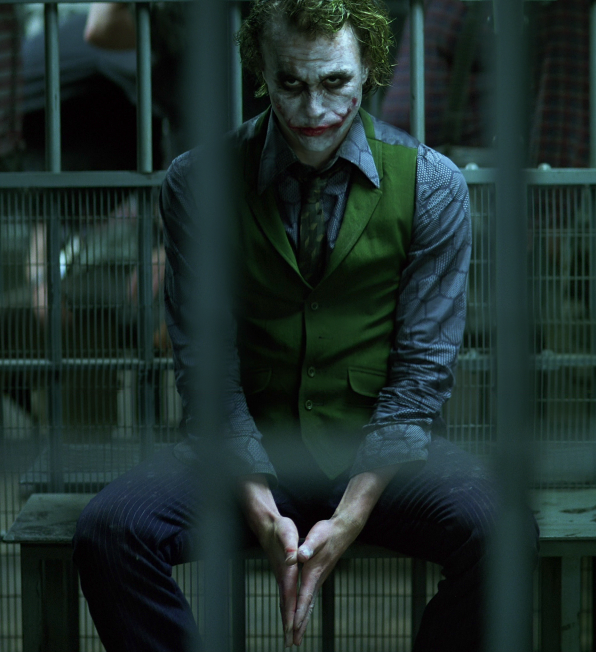
The real star of the film, however, is Heath Ledger as the sinister Joker. In January 2008, six months before the film's release, Ledger had passed away due to a lethal combination of prescription drugs. His death, already tragic due to his young age, was also a huge loss to the world of acting, as his performance in this film highlights just how excellent of an actor he was. To prepare for the role, Ledger reportedly spent a month in a hotel room, by himself, creating the character's voice, posture and even kept a diary as "The Joker." His hard work paid off as, in one of his final on-screen appearances (The Imaginarium of Doctor Parnassus being the final one), Ledger delivered a career-making, and furthermore, iconic, performance as The Joker.  Ledger's Joker is, as far as The Essential Films is concerned, the greatest screen villain of all time. Unlike previous incarnations of the character, this Joker had disturbing scars running up both sides of his mouth to form a sadistic smile that made the character even more psychotic than he already was. His wardrobe was still the flamboyant purple and green that audiences were used to, but toned down to work in the more realistic setting of Nolan's universe. The Dark Knight is a film about balance and duality.  Batman is the personification of justice, law and order while The Joker is the personification of violence and chaos (and Dent ends up encompassing both.)  Joker, originally hired to kill the Batman by the mob, instead refocuses his agenda to psychologically torture him instead. Why? Because it amuses him. He forces Batman chose between saving Harvey Dent or the love of his life, he goads Batman into killing him, he turns the people of Gotham against him and he terrorizes citizen for fun. Joker is chaos.  Ledger's manic mannerisms are sublime and add more menace to the already terrifying clown. Throughout the film he asks different victims if they want to know how he got the scars on his face, each time telling a different story, to the point that the audience wonders which story, if any, is the real story. Why does he do this? Because he is chaos. He wants to watch the world burn. He forces Batman and Dent to continually make morally questionable decisions to the point that he practically destroys everything they stand for. The character has so many iconic and quotable lines, thanks to the excellence of the screenplay and Ledger's delivery. Ledger brought so much depth to this character that it is no coincidence that he posthumously won every single acting award he was nominated for the following year.

And... here... we... go!


The Dark Knight is an excellent piece of filmmaking that is not limited to just the acting and the story. Nolan puts together a masterpiece, demonstrating his ability to craft a a highly satisfying piece of blockbuster entertainment while also creating a beautiful piece of art. He has demonstrated, from his first work in Following to his break-out film Memento all the way through last year's Dark Knight Rises, that he is one of this current generation's best filmmakers. Everything works in The Dark Knight. Each of the film's three acts has a satisfying payoff, while keeping a break-neck pace that leaves the audience wanting for more as it continues to escalate and the stakes keep raising higher and higher. The costume design on Joker is perfectly suited (pardon the pun) for the character and the production design make Gotham City look less like Chicago (where it was mostly filmed) and more like a real, tangible location.  The cinematography, specifically the IMAX shots, are gorgeous and should have won an Academy Award for Wally Pfister. And the score? Epic. In fact the only films in recent memory that have a more epic-sounding score are Inception and The Dark Knight Rises... both Nolan films, unsurprisingly. Hans Zimmer and James Newton Howard distinguish themselves from their Danny Elfman predecessor to create a score that perfectly incapsulates THIS universe.   

Sometimes people deserve to have their faith rewarded...

The film's legacy cannot be denied. The film was nominated for 8 Academy Awards, which was a record for a film based on comic book. Ledger's win for Supporting Actor was the first time any major Oscar category was awarded to a comic book movie, which went a long way in legitimizing the genre.  Which is exactly what it did. While superhero films always have a place in the "geek" community, they are oftentimes seen as popcorn entertainment. The Dark Knight showed critics, audiences and the Hollywood community that a comic book movie can be more than just entertainment, it can be legitimate art. In fact it was so successful amongst critics and audiences that there was legitimate controversy when the film was NOT nominated for Best Picture. Many feel that the following year, when the Academy expanded their nominees for Best Picture to ten films instead of five, it was to correct this mistake and allow more mainstream and genre films like District 9 and Avatar to compete.  The Dark Knight topped many Top 10 lists of the year (including the prestigious American Film Institute) as well as being named #15 in Empire Magazine's "500 Greatest Movies of All Time", #5 in Entertainment Weekly's "100 Greatest Characters of the last 20 Years" and Total Film's 6th most accomplished film of the last 15 years. Added to this are the multitude of awards and nominations (see above) and placement in almost every Essential Films countdown list including Greatest Villains, Greatest Heroes, Greatest Blockbusters and Greatest Films.  The film clearly resonated with audiences as it grossed over $1 billion at the box office worldwide (the first comic book film to ever do so). It is the 16th highest grossing film of all time worldwide, the 4th highest grossing film of all time domestically (behind Avatar, Titanic and Marvel's The Avengers respectively), the 2nd biggest superhero movie all time (behind The Avengers) and the biggest film of 2008.  When released to home media, The Dark Knight set a sales record for most discs sold in one day, totaling over 3 million purchases, including 600,000 Blu-rays.

The Dark Knight is the greatest superhero film of all time and an iconic masterpiece.

Why so serious?


Wednesday, September 18, 2013

Batman Begins (2005)


BATMAN BEGINS
Christopher Nolan
2005 • 140 Minutes • 2.35:1 • United States
Color • English • Warner Bros.


Cast: Christian Bale, Michael Caine, Liam Neeson, Katie Holmes, Gary Oldman, Cillian Murphy, Tom Wilkinson, Rutger Hauer, Ken Watanabe, Morgan Freeman
Writers:  Christopher Nolan, David S. Goyer (Screenplay); David S. Goyer (Story); Based on characters created by Bob Kane
Producers: Charles Roven, Emma Thomas, Larry J. Franco
Cinematography: Wally Pfister

Awards & Honors

Academy Awards
Nominated: Best Achievement in Cinematography - Wally Pfister

Academy of Science Fiction, Fantasy & Horror Films
Winner: Best Actor - Christian Bale
Winner: Best Fantasy Film
Winner: Best Writing - Christopher Nolan, David S. Goyer
Nominated: Best Director - Christopher Nolan
Nominated: Best Supporting Actor - Liam Neeson
Nominated: Best Supporting Actress - Katie Holmes
Nominated: Best Costumes
Nominated: Best Music - James Newton Howard, Hans Zimmer
Nominated: Best Special Effects

The Essential Films

100 Greatest Movie Villains: R'as al Ghul
100 Greatest Movie Heroes: Batman
Top 25 Superhero Movies


Why do we fall? So we can learn to pick ourselves up.

Batman Begins is a cinematic reboot of the troubled Warner Bros. Batman franchise. The original franchise (discounting the 1940s serials and the 1960s film based on the campy television show) blasted into theaters in 1989 to critical and financial success. In 1992, the Dark Knight returned to theaters with Batman Returns.  Returns succeeded critically and financially as well, though it was not quite as financially successful as the original 1989 film, taking in "only" $162 million compared to 1989's $251 million haul.  Executives felt the film went to dark and hired Joel Schumacher to replace Tim Burton as director for 1995's Batman Forever. Forever's lighter tone did indeed conquer the box office again with  $184 million. Executives loved Schumacher's lighter take on Bruce Wayne and company, and immediately hired him for Batman & Robin. While B&R did have a strong opening weekend, once word of its overly campy direction came out to audiences, sales dropped dramatically. Batman & Robin remains to this day the lowest grossing and biggest critical failure in the live action Batman entries.  The movie was so abysmally bad that Warner Bros. scrapped plans for an eventual 5th movie, Batman Triumphant.  And so, with the exception of some straight-to-video animated projects, one of the world's most recognizable superheroes sat on the cinematic shelf collecting dust for 8 years. A variety of different projects were thrown around, but it wasn't until 2003 when Memento writer/director Christopher Nolan was hired to takeover the franchise.

Batman Begins completely reboots the previously existing Batman universe.  It takes us to Bruce Wayne's beginnings as a young man, dealing with the rage and desire for revenge for the death of his parents. It follows his exploits across the world as he trains his body and mind for vengeance. One fateful day he meets a mysterious stranger who introduces him to The League of Shadows, a shadowy organization that metes out justice. Bruce takes what he learns back to Gotham City and wages his one-man war on crime as The Batman. While investigating the villainous Scarecrow and fighting Gotham's underbelly of criminals, he discovers a larger plot... one involving The League of Shadows and his former mentor, R'as al Ghul.  The film was a critical and financial success and it kicked off the first part in what was to become the epic Dark Knight Trilogy, culminating in 2012's billion-dollar hit The Dark Knight Rises.

The original Batman franchise had its share of talented A-list actors: Michael Keaton, Kim Basinger, Jack Nicholson, Danny Devito, Michelle Pfeiffer, Arnold Schwarzenegger, Tommy Lee Jones, George Clooney and Jim Carrey to name a few. Nolan's trilogy is not to be outdone.  Since grabbing Hollywood's attention with Memento, Nolan's worked with some top notch talent including Al Pacino, Robin Williams, Leonardo DiCaprio, Hugh Jackman and even David Bowie.  Batman Begins, and the rest of the films in the trilogy, are magnificently cast from the title character to the minor supporting roles.

Christian Bale takes the mantle of the Bat this time around, and to date is the actor who has most often donned the cape and cowl on the movie screen.  Billy Crudup and Jake Gyllenhal, as well as future Batman villains Cillian Murphy and Heath Ledger were considered for the role before Bale was ultimately cast.  Bale succeeds the most as Bruce Wayne, probably more so than any of his predecessors.  Bruce Wayne is a complicated character, as when he is alone and around his closest allies, like his ever-faithful Alfred, he is somber and brooding, but when making public appearances he puts on the persona of "Bruce Wayne: jet-setting, irresponsible playboy billionaire."  Bale is the first actor to take on the role who understood that delicate balance.  His Batman was also very good as a menacing vigilante. (The "voice" however has been a subject of much criticism.)

Michael Caine's Alfred is an interesting change of pace from Michael Gough's portrayal in the Burton-verse.  Gough's Alfred felt ancient and tired, where as Caine's is much livelier and witty.  The character is written more as a substitute father figure for Master Bruce.  Alfred is concerned about Bruce's welfare and sanity, yet he understands his desire for justice. He is torn between his duty to the Wayne family and his authentic love for the boy he helped raise.  Caine's performance as Alfred in these films is often criminally overlooked, but he is truly the heart of the trilogy. His final spoken lines in the series, towards the end of The Dark Knight Rises, are probably one of the most impactful and gut-wrenching scenes I've ever seen in a comic book film.

Liam Neeson enters the film early on as Henri Ducard, a mysterious member of the League of Shadows, who helps induct Bruce into a world of ninjas and vigilantes.  Neeson has a big reveal towards the end of the film that, if you haven't seen the film, I will not spoil here.  Needless to say, Liam Neeson shines as the would-be ninja mentor who teaches Batman all his tricks of the trade.  A constant theme in the film is Bruce's desire to find a father figure. Alfred fills that role somewhat, but he sees in Ducard someone who shares his pain and can mentor him. 

Commissioner Gordon, thus far portrayed on-screen as the bumbling Pat Hingle, gets a gritty reboot in the guise of Gary Oldman, in this film only a detective and one of the few uncorrupted cops on the Gotham City police force.  In Begins, Gordon is given extra relevance as a beat cop who helped comfort a young Bruce Wayne the night his parents were killed.  When Batman returns to Gotham City, he seeks out Gordon as an honest cop and forms a bond with him that will last the entire trilogy. Oldman as he does with every role, whether it's a good or bad film, absolutely nails the performance. To date this man has never won an Academy Award. This is a crime.

The film's villain, or so the audience is at first led to believe, is Dr. Jonathan Crane, also known as The Scarecrow, a twisted psychologist that performs experiments on his subjects through the use of a weaponized nerve gas that causes the victim to suffer extremely frightening hallucinations.  Cillian Murphy is cast as the villain and while younger than his comic book counterpart, he brings the creepy, calculating villainy of Crane to life for the first time on screen. 

Morgan Freeman, who like Gary Oldman also nails every role he's cast in, is cast as Lucius Fox, a Research & Development genius who has been demoted within the Wayne Industries hierarchy.  Lucius is ultimately responsible for arming Bruce with the tools and weaponry he goes on to use as Batman. What's refreshing about Fox is that he isn't an idiot, he immediately questions why a billionaire would want some of this gear and puts two-and-two together very quickly. Luckily, he's on the Dark Knight's side.

And these are just the main roles. Tom Wilkinson, Rutger Hauer, Ken Watanabe and Linus Roache, among others, are among some of the fine supporting cast in this film.

Batman Begins attempted, and succeeded, at something that previous Batman films had not: it grounded Batman in reality. Yes, the idea of a man dressing up in a bat costume and fighting crime is ridiculous and subject for fantasy. However, Nolan and his team did not make a fantasy film. They made a crime film with some fantasy elements. Batman's gadgets have scientific explanation behind them. His villains early on are mob bosses and psychopaths with nerve gas, not someone who can control plants or has a freeze ray.  His suit even seems more functional.  Instead of a rubber body suit with a leather cape, we get body armor with a lightweight cape that allows him to glide.  Even the Batmobile goes from fancy cool-looking, non-practical car to, essentially, a tank.

We can't close this entry without speaking about the cinematography.  Wally Pfister was nominated for an Academy Award for Best Cinematography for this film and it shows.  Supposedly, Nolan screened  for Pfister to convey the look he was going for. I'd say he nailed it. The film looks dark and gritty, yet realistic and futuristic at the same time. Nolan shot in Chicago for most of the Gotham scenes and added in a post-produced "Narrows" to show the slums of the city.  While Burton's 1989 film made Gotham City look like a fantasy, Nolan and his team created a Gotham City that looked credible, real and authentic. A city that could conceivably have a man dressed as a bat fighting crime.   
Blade Runner

Batman Begins is a landmark in comic book filmmaking. It took the hero seriously, grounded him in reality, gave not only him but his supporting players and his villains a motivation and character arcs.  And of course, it jump started one of the most successful film franchises in history with it's two sequels each earning over $1 billion.  Batman Begins is an essential film for starting a franchise, revitalizing a genre and rebooting a character that most had written off as a campy goofball.  

It has become more than just a movie. It devoted itself to an ideal and became something else entirely.

Are you ready to begin?

Wednesday, July 10, 2013

Batman – Mask of the Phantasm (1993)


BATMAN: MASK OF THE PHANTASM

Eric Radomski, Bruce Timm

1993 • 76 Minutes • 1.33:1• United States

Color • English • Warner Bros.

Voice Cast: Kevin Conroy, Dana Delany, Hart Bochner, Stacy Keach, Abe Vigoda, Mark Hammill
Screenplay: Alan Burnett, Paul Dini, Martin Pasko, Michael Reaves based on characters created by Bob Kane and Jerry Robinson

Producers: Benjamin Melniker, Eric Radomski, Bruce Timm

Awards & Honors

The Essential Films
Top 25 Superhero Movies – #20


Whoops! Ha! I guess the joke’s on me. You’re not Batman after all. Looks like there’s a new face in Gotham and soon his name will be all over town… to say nothing of his legs, and feet, and spleen, and head…

Batman is on the trail of a homicidal vigilante that is killing Gotham City’s top mob bosses while at the same time dealing with the re-appearance of an old love. To complicate matters: The Joker enters the fray as a wild card. Can Batman keep the Joker at bay while solving the mystery of Phantasm?

WARNING: Spoilers

After the success of the first two Tim Burton Batman films, Warner Bros. Animation green lit a cartoon to be aired on the Fox Network. Shortly after Batman Returns hit the big screen, “Batman: The Animated Series” hit the airwaves just in time for the fall schedule in 1992. The show proved to be a big ratings success and soon a feature-length direct-to-video adaptation was planned. At the last moment, however, Warner Bros decided that it wanted to shoot for a Christmas Day theatrical release, giving the animators a tough deadline to meet. Though the team of Eric Radomski and Bruce Timm were able to release the film on time and on schedule, but due to the last minute switch to theatrical release, there wasn’t a proper marketing campaign behind the film and it ultimately failed at the box office. It did receive widespread critical acclaim, however.

The main voice cast of the animated series returned for the film. Kevin Conroy returns as the animated Dark Knight. Conroy is, in my opinion for whatever that’s worth, the best Batman ever… animated or otherwise. Conroy did something that no one else has successfully accomplished: His Bruce Wayne is the “mask” and Batman is the real person. He accomplishes this by making the Bruce Wayne voice sound “higher” than his “real” Batman voice. The Batman voice that Conroy puts on is iconic and to this day the voice that best personifies everything that character is supposed to be. Unlike Christian Bale’s “growl” voice, Conroy’s Batman voice is his real voice… the Bruce Wayne voice is the fake voice. It’s brilliant voice performance.

Luke Skywalker himself, Mark Hammill, provides the voice of The Joker. Unless you’re new to the Batman mythology, you’ll know that Hammill’s Joker voice is beloved by Bat-fans everywhere. As I said recently on the Forced Perspective podcast’s Batman specials, every Joker, whether it was Caesar Romero, Jack Nicholson, Heath Ledger or Mark Hammill was perfect for the “universe” they were set in. Hammill’s Joker was perfect for what was to become the DC Animated Universe.

Dana Delany plays Andrea Beaumont, a former lover of Bruce Wayne. Through a series of flashbacks we see that Andrea nearly derailed Bruce from becoming Batman. Bruce proposes, but she ultimately abandons him mysteriously leading him back on the path to become Batman. Delany is quite good in this role and she eventually returned to the DCAU as Lois Lane in “Superman: The Animated Series.”
Hart Bochner, Stacy Keach and Abe Vigoda all provide guest starring voices as a crooked City Councilman and mobsters respectively. Vigoda is especially entertaining as Sal Valestra. Efrem Zimbalist Jr., Bob Hastings and Robert Costanzo reprise their roles as Alfred, Commissioner Gordon and Detective Bullock and provide the usual fine performances they provided to the Animated Series (however brief their screen time may have been.)

Overall this is one of the better written Batman films in terms of thematic elements as well as an exploration of the Batman character. When Andrea leaves Bruce, it leads to his decision to finally become Batman. In the future, to avenge the death of her father Andrea becomes the Phantasm. Both Bruce and Andrea are driven by an urge avenge their dead parents, and therefore reject the notion of love. This film also includes the most revealing moment in the tragedy that is Bruce Wayne. In a flashback sequence, he is tortured by the guilt that he no longer wants to fight evil. He wants to be with Andrea, and he kneels at the grave of his parents and cries “I didn’t count on being happy.” Later after Andrea leaves him and he, again rejecting love, dons the Batman mask for the first time… Alfred let’s out a “My God!” at the horror he feels at seeing it. Bruce Wayne is transformed… he is now truly Batman. It’s a fantastic scene.

Batman: Mask of the Phantasm, much like “Batman: The Animated Series” is perhaps the film that is the closest to the Batman comic book character. This despite having a villain created just for the film. It’s sleek and stylish, and even at only 70 minutes, packs an impressive amount of character development and action. Certainly one of the greatest animated films of all time.


Monday, July 1, 2013

Batman on Film Part 7: The Animated Movies


On this edition of “Batman on Film,” we’re looking at all the animated films featuring our Dark Knight hero. Now, we’ve already discussed Batman: Mask of the Phantasm in a separate feature, so we won’t discuss it here. In this article we will discuss the straight-to-video features released starting in 1998 through the current day. Note that team-up films like Superman/Batman: Public Enemies or Justice League: Doom won’t be considered as Batman is not the main focus of the film.  Here we go:

SUBZERO
Boyd Kirkland
1998 • 70 Minutes

On the Forced Perspective podcasts focused on the Batman animated series, me and the crew discussed at length many of the wonderful single episodes the series produced. Chief among them was one of the first ever aired on television, “Heart of Ice.” This episode is responsible for creating the Mr. Freeze origin story that everyone accepts as canon now, and was later used in Batman & Robin.  SubZero was actually supposed to be released simultaneously with Batman & Robin’s theatrical release, but was pushed back due to poor critical reception of the infamous disaster of which that film became to be known.  SubZero takes place after the “Batman: The Animated Series” episode “Deep Freeze.” Victor Fries has moved to the Arctic to live in an environment that keeps both himself and his cryogenically-frozen wife, Nora, alive.  Her containment unit becomes ruptured and he is forced to travel back to civilization to find an organ donor to save his dying wife. Freeze discovers that the perfect donor match is Barbara Gordon, daughter of Commissioner Gordon and secretly Batgirl, and will take her dead or alive to save his wife. Enter Batman and Robin to save the day.  The films plays out much like 3 part “Batman” episode, which isn’t a bad thing.  The action is exciting and the artwork, as always from this production crew, is outstanding.  Kevin Conroy brings it, as always, to the role of Bruce Wayne and Batman while Michael Ansara is a perfect Mr. Freeze, with his dead-panned, cold (pardon the pun) delivery of his lines.  SubZero certainly faired better with critics than its live-action companion did, and even won an Annie Award (awards for animation) for Best Home Video Animation.
Grade: B+

RETURN OF THE JOKER
Curt Geda
2000 • 77 Minutes

In 1999, Batman made his return to animated series with “Batman Beyond.” This time, however, we join Gotham City in the future, where Bruce Wayne is an old man who has retired from crime-fighting. But he’s not done with the scum of Gotham City’s underbelly yet, this time he mentors Terry McGinnis, a new Batman, on how to be The Dark Knight of tomorrow. The series was received by incredibly-skeptical fans that were not fans of this non-canon interpretation of their beloved Batman. However, their expectations were exceeded when “Batman Beyond” went on to become an exciting, action-packed, yet futuristic take on Batman that still remained true to the spirit of the character we all love.  In 2000, Warner Bros. Animation released Batman Beyond: Return of the Joker on home video. The film’s plot is in the title, as The Joker, long-thought to be dead, has returned to terrorize Gotham City. Both Bruce and Terry have to investigate the return of the Clown Prince of Crime and determine whether he is the real Joker and how he has managed to return from the grave. The film’s highlight is a flashback sequence that takes the viewer back to a “Batman: Animated Series”-style sequence that shows Batman and Batgirl attempting to rescue Robin from The Joker and Harley Quinn. The scene reveals that The Joker has mentally, physically and psychologically tortured Tim Drake past the point of no return, which causes Batman to completely lose his temper. I won’t give away what happens, but The Joker meets his apparent death in a shockingly violent manner.  This was a point of contention with executives as the MPAA gave the film a PG-13 rating due to the violence. Warner Bros. panicked and re-edited the film to a much tamer version, cutting down on a lot of the dramatic and emotional impact. When the kid-friendly version did not perform well financially, the film was released completely intact in an “Original Uncut” version.  The rest of the film is quite good as well, with the mystery of how the Joker survived his apparent death providing a good mystery for the caped crusaders to solve.  Mark Hammil returns to voice The Joker, and he’s at his maniacal best. Will Friedle plays Terry McGinnis as a brash, young kid still learning the ropes while Kevin Conroy transitions perfectly from Batman in his prime, to an old, crotchety Bruce Wayne.  The film packs a lot of drama and emotion, and, thanks to the darkness of the flashback sequence, a satisfying climax at the end of the film. One of the best.
Grade: A-

MYSTERY OF THE BATWOMAN
Curt Geda
2003 • 75 Minutes

Batman: Mystery of the Batwoman, much like SubZero, plays like an extended episode of “Batman: The Animated Series,” which again, is not a bad thing.  This was the last solo-Batman film released that takes place in the “DC Animated Universe.” Batman would later re-appear, voiced by Kevin Conroy, in Justice League features.  The film is rated PG, so a little more freedom than the television show, but not quite as dark as Return of the Joker. Batman is back in present day this time, and he’s trying to solve the mystery of a new heroine that has invaded Gotham City and has taken to dressing herself up like him. This new “Batwoman” is reckless, which Batman doesn’t exactly appreciate, and is trying to take on the likes of some of Batman’s foes, namely The Penguin and Rupert Thorne.  Batman’s main priority is to stop this new Batwoman from doing more than good, and he uses his detective skills to figure out who she is. Batwoman herself is played by Kyra Sedgwick, and the film, in a bit of clever voice casting, introduces 3 female characters that all have an agenda and could possibly be Batwoman. The 3 characters (Kathy Duquesne, Rocky Ballantine and Sonia Alcana) all have similar sounding voices, which throws the audience off.  It’s a clever trick and the payoff to the mystery is amusing.  Ultimately, not a great film, but not bad either.
Grade: B-

GOTHAM KNIGHT
Anthology
2008 • 75 Minutes

In 2007, DC Comics started up the DC Animated Original Movies line, where it took stand-alone concepts or sometimes straight comic book stories and adapted them to full-length features. Some of these have worked like Superman: Doomsday and Wonder Woman. Others like Gotham Knight, have not. This collection of six short animated Batman films was released in time with the now-classic The Dark Knight in 2008. The six short films were supposed to bridge the gap of what happened between the movies Batman Begins and The Dark Knight and depicts Batman in the “Nolan Universe.” Segments of the film were written by Batman alumni like David S. Goyer, Brian Azzarello, Greg Rucka and Alan Burnett, so you’d think at least one of the stories would be captivating. Sadly not. The producers took a page out of the Wachoski playbook and all the stories are done in an “Anime” style. Sadly, the Japanese animation style just doesn’t fit in the Batman universe. This anthology did have one saving grace at least: Kevin Conroy as Batman. His voice as The Dark Knight will never and can never be outdone.
GRADE: D

UNDER THE RED HOOD
Brandon Vietti
2010 • 75 Minutes

Thankfully, all is not lost for Batman. DC Animated Original Movies delivered Batman: Under the Red Hood in 2010.  Red Hood was adapted from two Batman shorelines: “A Death in the Family” and “Under the Red Hood.” The film starts in flashback and depicting the brutal death of Jason Todd, one-time companion to Batman as Robin, at the hands of the Joker. In present-day Gotham City, Batman is a war with Gotham’s criminals (as always) and teaming with Nightwing, another former Robin, taking down an android known as Amazo. Batman and Nightwing investigate what connection Gotham City gangster, Black Mask, has with the robot, and find that there is a rogue vigilante known as The Red Hood involved in a turf-war with Mask.  The Joker, who was the original Red Hood, is interrogated and denies involvement. In the end, we find out how Red Hood, Joker, Jason Todd and even Ra’s al Ghul are all connected.  The film borrows heavily from the source material to great effect and it should make many comic book geeks very happy with its faithfulness. For the first time in a stand-alone Batman film, Kevin Conroy and Mark Hammil do not provide the voices of Batman and Joker. Bruce Greenwood (Star Trek, Double Jeopardy) does a fine job as Batman, but it is jarring not to hear Conroy.  John DiMaggio, best known for his work as Bender in “Futurama”, provides the voice of The Joker. His approach is much different than Hammil’s maniacal take, and voices the character in a much more subdued and disturbing way. Hammil’s work will always win “Best Joker” polls, but DiMaggio, again, isn’t bad… just different.  Jensen Ackles and Neil Patrick Harris provide good supporting work as Red Hood and Nightwing respectively.  A damn good film.
Grade: A

YEAR ONE
Sam Liu, Lauren Montgomery
2011 • 64 Minutes

If you’ve seen Batman Begins, you’ve seen the skeletal structure of this film. Batman Begins borrows heavily from Frank Miller’s Batman: Year One 1987 storyline which tells the first year of Batman fighting crime in Gotham City, including the beginning of his alliance with Jim Gordon. This film is a straight adaptation of the 4-issue story arc.  A lot of the plot points will seem familiar.  Bruce Wayne returns from traveling the world, where he learned various forms of fighting disciplines to wage war on the criminals of Gotham City.  James Gordon has just moved to Gotham City and begun working in the Gotham City Police Department. Both Wayne and Gordon become acquainted with the corruption of the police force and its elite citizens.  Bruce Wayne becomes a masked crimefighter, while Gordon forms an uneasy alliance with a vigilante criminal to take down the greater evils in Gotham. There’s a reason Christopher Nolan borrowed so heavily from this story: it works. It’s captivating. It’s true to the spirit and character of Batman.  Benjamin McKenzie (88 Minutes) provides the voice for Batman this time around. Again, he’s no Kevin Conroy, but who is. Eliza Dushku (Buffy the Vampire Slayer, Dollhouse, Jay and Silent Bob Strike Back) joins the Bat Universe as a pre-Catwoman Selina Kyle and Bryan Cranston (Breaking Bad) kicks ass as Commissioner Gordon, probably the best voice acting for the character, with all respect to Bob Hastings.  Again, this retelling of Batman’s origin will not provide any surprises, but it is an excellent source of Batman entertainment for new and old fans alike.
Grade: B

THE DARK KNIGHT RETURNS PARTS 1 & 2
Jay Oliva
2011-2012 • 152 Minutes 

The Dark Knight Returns was released as two parts, but they really must be seen as one film. One can’t talk about the films without referencing the source material. In 1986, DC Comics released The Dark Knight Returns, a 4-part graphic novel that takes place in an alternate future where Batman has retired due to old age. After Harvey Dent, whose face was fixed and declared mentally sane, disappears and crime starts to become an epidemic in Gotham once again, a 55- year old Bruce Wayne dons the cape and cowl to strike fear into Gotham’s criminals.  He tracks down Two-Face, wages ware against a street gang known as The Mutants and eventually inspires them to become a gang of vigilantes instead. A new Robin joins him, this time a teenage girl named Carrie Kelly. Batman’s sudden reappearance in Gotham sparks the interest of The Joker and the US government. The Joker, who had been catatonic due to the lack of Batman in his life, reawakens and goes on a killing spree, while the government, feeling a loss of control to a vigilante, sense none other than Superman to clean up the “mess.” The Dark Knight Returns is more than just a superhero story. It’s an epic and tragic opera. And it’s perfectly adapted to the screen with these straight-to-video masterpieces. Almost everything from the book, with the exception of Batman’s inner monologue, is brought to life. Batman is voiced by Robocop himself, Peter Weller, while Modern Family‘s Ariel Winter plays Robin. Weller’s performance as Batman is jarring, but perfect given the context of the story. This Batman is a hulking slab of meat, and Weller’s deep voice provides the right amount of menace.  Michael Emerson (Lost) plays the Joker beautifully, (but again, he’s no Mark Hammil) and provides a worthy foe to The Dark Knight.  The entire voice cast works, even Conan O’Brien as a talk-show host that meets a grizzly end at the hands of The Joker.  If you’ve read the book, you owe it to yourself to watch this film.  If you haven’t, watch this film then read the book. One of the best Batman films ever made.
Grade: A+

Monday, March 25, 2013

Batman on Film Part 6: Batman & Robin


BATMAN & ROBIN
Joel Schumacher
1997 • 125 Minutes • 1.85:1 • United States
Color • English • Warner Bros.

Cast: Arnold Schwarzenegger, George Clooney, Chris O’Donnell, Uma THurman, Alicia Silverstone
Screenplay: Akiva Goldsman
Producer: Peter Macgregor-Scott
Cinematography: Stephen Goldblatt

Awards & Honors

Academy of Science Fiction, Fantasy & Horror Films
Nominee: Best Costumes
Nominee: Best Fantasy Film
Nominee: Best Make-Up

The Essential Films
100 Worst Films of All Time – #24

Razzie Awards
Winner: Worst Supporting Actress – Alicia Silverstone
Nominee: Worst Director- Joel Schumacher
Nominee: Worst Original Song – Billy Corgan For the song “The End is The Beginning is The End”
Nominee: Worst Picture
Nominee: Worst Reckless Disregard for Human Life and Public Property
Nominee: Worst Remake or Sequel
Nominee: Worst Screen Couple – George Clooney, Chris O’Donnell
Nominee: Worst Screenplay
Nominee: Worst Supporting Actor – Chris O’Donnell
Nominee: Worst Supporting Actor – Arnold Schwarzenegger
Nominee: Worst Supporting Actress – Uma Thurman

There is no defeat in death, Master Bruce. Victory comes in defending what we know is right while we still live.

Oh man. Here we go. I’ve been avoiding this, but it looks like the time has come. I must review it. Batman & Robin is by far the worst Batman film ever made and hopefully that ever will be made. If not for the existence of Superman IV: The Quest for Peace, this would undoubtedly be the worst comic book film of all time. Ever. Period.

Since Batman Forever did so remarkably well at the box office, it seems Warner Bros. just looked at Joel Schumacher and said “You know what, just do whatever you want. You got this.” And boy, did he ever. He took everything that made Batman Forever bad and amped it up to 11. Back where the Bat Nipples, the ass shots, and smiling Batman. It’s just a train wreck of a film.

This time around Batman has to deal with a rampaging Mr. Freeze, who is doing cold-related crimes to steal diamonds and power his suit. Freeze teams up with Poison Ivy to terrorize Gotham City, all the while Alfred is dying and his niece Barbara Wilson (not Gordon) has come to visit. Barbara by the way ends up being Batgirl. Oh! And Bane is in this movie too! Remember how awesome he was in The Dark Knight Rises? Yeah, well… let’s just say he had some humble on-screen beginnings.

Batman & Robin released (escaped) on June 20, 1997 to a juggernaut of terrible reviews. (It’s currently rocking a 12% on Rotten Tomatoes.) Despite that, the film did well on its opening weekend, raking in $42 million. But the following week saw it plunge drastically as word-of-mouth got around of just how absolutely awful this film is. Critics blasted it for it’s campy approach. Schumacher made a very good big-screen version of the 1960s camp TV show, but in 1997 no one wanted to see that.

So how bad is this film? Well…

You’ve got Arnold Schwarzenegger as Mr. Freeze. Not quite what you expected when you pictured the comic book character? Yeah, 1997 comic books fans didn’t either. Interestingly enough, Mr. Freeze in this film borrows the origin story from his “Batman: The Animated Series” counterpart, in where Dr. Victor Fries suffers a terrible accident that leaves in his “frozen” state while trying to find a cure for his beloved Nora. That’s as faithful to source material as you’re going to get, because from this point on Freeze is a PUN MACHINE. Check it out:


It’s so campy it hurts.

George Clooney becomes the fourth actor to portray Batman on-screen in a major motion picture. Clooney, for his part, is fine. His acting choices aren’t really his fault. He essentially plays an updated version of Adam West, and in that sense, he succeeds. Clooney was cast after Val Kilmer and Joel Schumacher discovered that they just could not work together during the filming of Batman Forever. His Bruce Wayne is actually pretty good, his Batman is goofy, but again, that’s what this movie was supposed to be. Of all the complaints you can have of this film, Clooney is probably the least troublesome.

Chris O’Donnell returns as Dick Grayson, a.k.a Robin. And guess what? He still kinda sucks. They never quite explained why a 25 year-old MAN needs to be adopted by a billionaire, but it certainly added (intentionally or unintentionally) to the homosexual vibe the film had going for it. The film essentially killed his career for almost 15 years. It’s only recently that he’s started appearing in higher-profile roles such as on television’s “NCIS.” Of the film O’Donnell said “I felt like I was making a kid’s toy commercial.” That’s how we felt watching it, Chris.

Uma Thurman portrays Poison Ivy. Sigh. Really? Poison Ivy is supposed to be a seductive knock-out. And while I love her as “The Bride” in Kill Bill, Uma Thurman always kind of strikes me as a dirty hippie and not a devilish temptress that Ivy is supposed to be. She was horribly miscast, but in the end result of this film… does it really matter? Thurman was obviously cast because after the success of Pulp Fiction, she was kind of an “It” girl.

Alicia Silverstone. Talk about stunt casting. After Clueless was such a huge box office and cultural success, Silverstone went on to skyrocket to stardom and was cast in a wide array of box office… failures. While she was great as a ditzy blonde in a high school movie, she came up short playing anything else. Including Batgirl. And why wasn’t she Commissioner Gordon’s daughter? Well that probably had a lot to do with the fact that Gordon was really downplayed in this series of movies, and when he did show up he was kind of a buffoon. Thankfully his next appearance on the big screen did him justice. So Silverstone was made to be Alfred’s niece from England (where was her accent?), which pretty much was just a set up for her to discover the Batcave and become Batgirl. So nice that there was convenient crime-fighting costume in just her size in the Batcave. And why the hell didn’t HERS have nipples? Bull shit.

And then there’s Bane. Jesus. Remember how awesome Tom Hardy was in The Dark Knight Rises? Remember how he OWNED that role? Yeah, well, take that performance and that character portrayal and think of the exact opposite. THIS Bane, played by roided up ex-pro wrestler Jeep Swenson, never speaks, never breaks Batman’s back, and is essentially just a hired thug that goes around saying “Bomb. Bomb. Bomb.” Fuck. It’s terrible.

As stated before, the severe box office drop off and thrashing it received from critics, caused Warner Bros. to cancel the planned 5th movie in the series, titled Batman Triumphant. It was actually already in pre-production with O’Donnell and Clooney verbally committed to return. Again, after the failure of the last film, they both swore off making another one. Batman Triumphant started pre-production work when Warner Bros. executives were happy with the dailies they saw coming in from the set of B&R. In this incarnation, The Scarecrow (played by Howard Stern) was set to be the main villain terrorizing Batman with his sidekicks Harley Quinn (who was getting revenge for The Joker’s death) and Mad Hatter. Considering how Batman & Robin turned out, we should probably be thankful Warner executives cancelled this thing.

And that’s that. For 8 years Batman would not appear on the big screen. He would have straight-to-video releases like Batman & Mr. Freeze: Sub-Zero, Batman Beyond: Return of the Joker and Batman: Mystery of the Batwoman (which are all better than Batman & Robin) but it wouldn’t be until an up-and-coming director would take the reins in 2005 that we would get perhaps not the Batman we deserve, but the one we needed.

All that said, Batman and Robin is almost worth watching. If for any other reason than from a “it’s so bad it’s good” kind of angle.  See you next time.

BATMAN & ROBIN is available on DVD and Blu-Ray, as well as for digital rental or purchase via iTunes, Google, YouTube or Amazon.